 Network North
Gross wages, net pay and what your umbrella quote includes
You are discussing a project in Norway. The agency gives you a rate, an umbrella provider gives you a salary calculation, and you want to know what will hit your bank account. All three figures can be correct, yet describe different things.
A Norwegian contract rate has to cover wages, holiday pay, employer contributions, pension, insurance and the provider’s fee. Your take-home pay depends on income tax. Understanding how these fit together helps you compare offers and decide whether an assignment works for you.
Which rate are we talking about?
Recruitment agencies often discuss the all-inclusive rate: the amount to cover all employment costs. The umbrella or Employer of Record (EOR) provider is concerned with wages and so are Norwegian candidates. Foreign candidates may be more concerned with anticipated net pay.
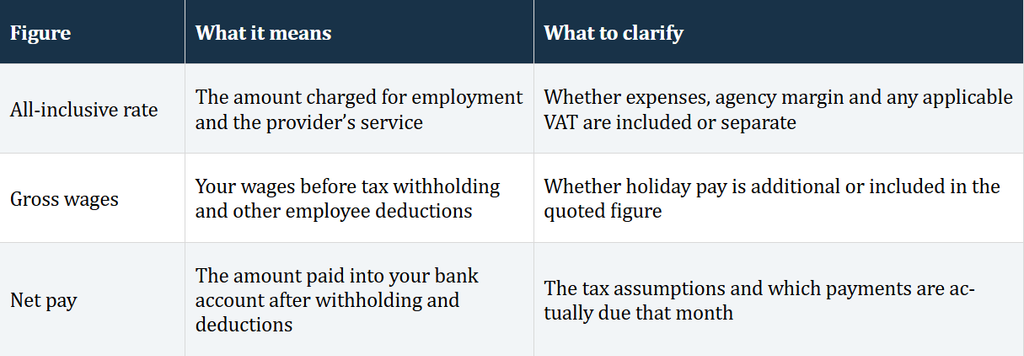
For instance, an all inclusive-rate of EUR 70 per hour may mean that:
- The agency pays the umbrella provider EUR 70
- Tax-liable pay may be EUR 51 per hour + holiday pay
- Net pay may be EUR 38 + holiday pay
Also compare the same number of hours. An hourly quote based on 160 hours and a monthly estimate based on 180 hours will give different results before any fees or taxes are considered.
How the total rate becomes net pay
There are two calculations. First, the total rate covers gross wages, holiday pay, employer costs and the administration fee. Then, tax withholding and any other agreed employee deductions are taken from the gross pay actually paid to arrive at net pay.
Employer costs include employer National Insurance contributions, occupational pension and insurance. Holiday pay may appear as its own line or be included in a combined gross-pay figure. Either presentation can be understood, provided the quote shows what is included and avoids counting it twice.
Some amounts are set aside for later payment. This means a breakdown of the total employment cost is not necessarily a prediction of your next bank payment.
Why holiday pay needs its own explanation
In Norway, holiday pay compensates for loss of wages as holidays are unpaid. It is accrued in one calendar year and paid the following calendar year, or at the end of the contract – whichever comes first. The statutory minimum rate is 10.2%, but 12% is most common. Higher rates apply to employees entitled to the additional holiday week from age 60.
An umbrella quote should explain the percentage, calculation basis and payment timing. An amount set aside for future holiday pay should be distinguishable from the net wages you will receive each month. Employers are not permitted to pay holiday on an ongoing basis.
Holiday pay is taxable. The fact that it may be paid without tax deductions under the general tax rules does not make it tax-free.
What National Insurance covers
Norway’s National Insurance Scheme, or folketrygden, is the public social security system. Membership gives access to healthcare and various social benefits such as sick pay, parental pay, unemployment benefits and disability benefits, as well as state retirement pension. Each benefit has its own conditions and limits.
There are two contributions to distinguish:
Employer’s National Insurance contribution — arbeidsgiveravgift. This is an employer cost included in the total rate. The applicable percentage depends on the relevant geographic zone. Most employers must pay 14,1% of all tax-liable pay, pension and benefits in kind.
Employee’s National Insurance contribution — trygdeavgift. This is part of your personal tax calculation and is collected through payroll tax withholding. It is included in both PAYE and general tax rates.
National Insurance contributions help fund the public system. They are not payments into a personal savings account, and paying tax in Norway does not by itself establish membership or entitlement to every benefit.
Workers posted to Norway by their foreign employer may be exempted from Norwegian national insurance contributions if an A1 certificate has been issued in the home country.
What occupational pension means
The pension line in your quote is usually occupational pension, known in Norway as obligatorisk tjenestepensjon or OTP. This is an employer-funded pension arrangement with a pension provider, separate from the state pension under National Insurance.
The employer must contribute at least 2% of taxable pay, capped at NOK 2,731 per month. upon retirement.The contributions are placed in a pension fund and are paid out upon retirement.
Ask which pension provider is used, what contribution rate applies and what salary forms the calculation basis. Any pension administration or related insurance costs should be identifiable separately from the contribution credited to your pension.
Which insurance is included?
Norwegian employers must provide occupational injury insurance, or yrkesskadeforsikring, for their employees. It covers work-related injuries and occupational illnesses.
At Network North, our insurance arrangements also include cover for travel to and from work and business travel. These are useful distinctions for contractors who travel regularly for assignments.
When comparing quotes, ask for the types of insurance included and a summary of the cover. Clarify whether commuting, business trips and journeys between your home country and Norway are covered. The word “insurance” alone does not explain the geographical scope, exclusions or benefit limits.
Why a net-pay estimate depends on tax assumptions
Two providers can calculate different net pay from the same employment budget simply because they use different tax assumptions.
For eligible foreign workers, the standard PAYE rate is 25% in 2026, including the employee’s National Insurance contribution. PAYE has eligibility conditions, including an annual income limit. Under general taxation, tax depends on annual income and personal circumstances, and qualifying deductions may be claimed.
Under the general taxation scheme, payroll withholding is an advance payment towards the final tax assessment. A low withholding estimate can make a quote look attractive, but all taxes are ultimately payable.
Ask which tax scheme the estimate uses, what annual income it assumes and whether deductions or a social security exemption have been included. For more on the registration process, read our guide to D numbers and tax cards in Norway.
What to check in an umbrella quote
Compare quotes using the same rate, currency, hours, holiday-pay treatment and tax assumptions. Then ask:
Can I see the full breakdown? Wages, holiday pay, employer contributions, pension, insurance and fees should be identifiable.
What will I receive now, and what is set aside? Separate monthly net wages from holiday pay accrued for later and pension savings.
What assumptions produce the net figure? Check annual income, tax scheme, deductions and any social security exemption.
Are all fees disclosed? Ask about onboarding, ongoing administration, pension administration, currency conversion and any exit charges.
How are assignment-specific costs handled? Clarify travel, accommodation, overtime, shift allowances and public holidays where relevant.
Who employs me, and when am I paid? Confirm the employer’s legal identity, payroll arrangements and the terms that apply if the agency or client pays late.
If one quote produces substantially more net pay from the same budget, ask the provider to explain the difference in writing. It may reflect a lower fee or a valid difference in circumstances. It may also reflect deferred holiday pay, omitted costs or a tax assumption that does not apply to you. A clear explanation makes the comparison useful.
Calculate from your budget or your desired net pay
Our Norway cost calculator offers three starting points for your calculation:
Start with the total budget to estimate how much can go towards wages and what the resulting net pay might be.
Start with your desired net pay to estimate the gross wages and total employment budget needed to support it.
Start with gross wages to estimate the employer costs and total budget alongside your take-home pay.
The calculator gives a monthly breakdown and lets you adjust assumptions such as holiday pay, pension, employer National Insurance, insurance and administration fees. You can use NOK or EUR; the current EUR display uses a fixed illustrative exchange rate of NOK 11 per EUR.
You can check if you benefit from the general or PAYE tax scheme.
The result is an estimate. Contact us for a detailed quote based on your circumstances.
Get a breakdown for your Norwegian assignment
At Network North, we help contractors and agencies understand how the agreed rate translates into Norwegian employment and pay. We can explain the assumptions behind the calculation and how holiday pay, pension and insurance are handled.
Have a rate or an offer you are trying to understand? Contact Network North with the rate, expected hours, work location and planned assignment dates. We can prepare a breakdown and discuss what the figures mean for you.
Last reviewed October 2026